
Every email arrives with proof it’s on brand.
Caliber Email will write every email from your own brand guide, and each one will reach you with a score that shows its work, so you see why it is on brand without reading every line. Your brand guide will become the rules it writes from: versioned, owned by you, and every line traceable to one. Your team calibrates the score, and each finding will show the line, the rule behind it and a suggested rewrite. The score informs the decision; a named person approves.
Integrations: Klaviyo · Braze · Salesforce MC Next · Voyado · Customer.io · Iterable
01 / What changes
What changes for the person who answers for the brand?
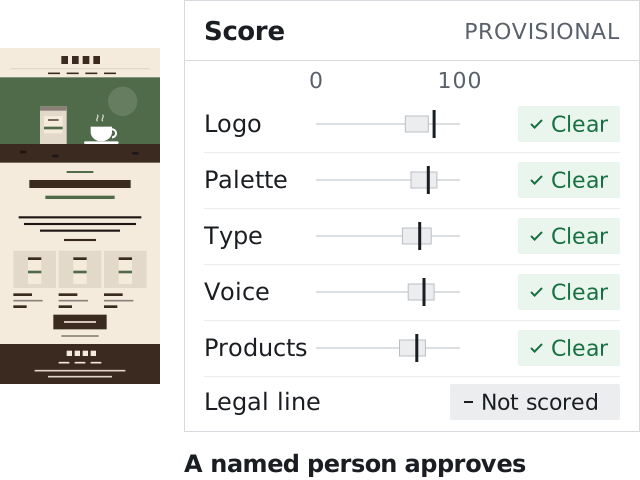
For a Head of Brand or Creative Director, the change is that looking at every email stops being the only way to protect the brand. Each email will reach you with a score that shows why it holds to your guide, line by line, and the findings that need your eye.
So the score comes first: which of your rules each line was written from, how it scores against them, and what nobody has scored yet.
02 / The rule
How does a brand guide become the rule?
A brand guide becomes the rule when each trait it describes is written as a dimension that can be scored. Each dimension will have a weight, a guidance range on a 0–100 scale, and lines that show what a high and a low score sound like.
Your brand sets all of it, and Caliber holds no rubric of its own.
-

Word rules, matched in code.
Words your brand never uses never reach the draft. Watch-words and length limits will be matched exactly and flagged with the exact words. A model never decides a word rule.
-

Voice, read and scored.
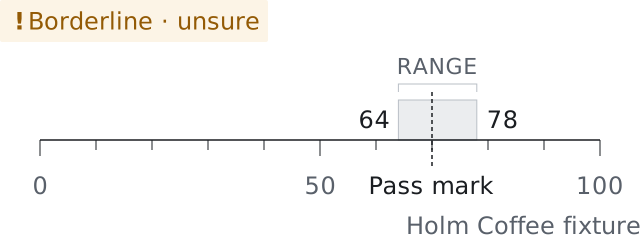
Voice traits and writing rules need reading. Each draft will be scored more than once, so the result is a range rather than a bare number, labelled provisional until the scorer has been measured on your own emails.
The brand voice guide template has a section for each part of a rubric.
Brand voice guide template03 / A finding
What does a finding show?
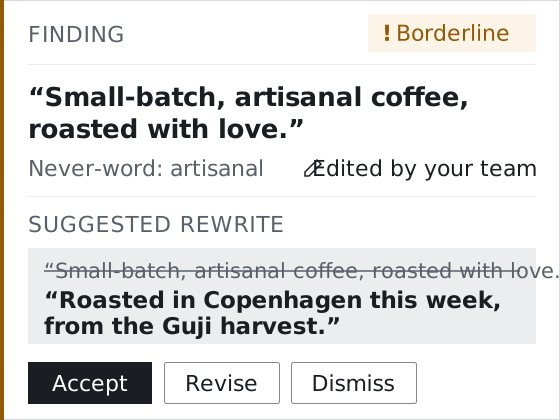
A finding shows where a line and your rules part ways, most often on a line someone edited after Caliber wrote it. It shows three things: the line as it stands in the draft, the rule in your guide that it breaks, and a suggested rewrite that can stand in for the line as written. The reviewer then accepts the rewrite, revises it or dismisses the finding.
- The line
- “Small-batch, artisanal coffee, roasted with love.”
- The rule behind it
- Holm’s guide lists “artisanal” as a never-word, and every origin story names the farm.
- Suggested rewrite
- “Roasted in Copenhagen this week, from the Guji harvest.”
- The reviewer’s choice
- Accept the rewrite, revise it, or dismiss the finding
One finding on a line a person edited in a Holm Coffee email. Holm Coffee is a fictional demo brand; the lines are illustrations.
Dismissing will be allowed: a finding is Caliber’s reading of your guide, and your team can disagree with it.
How Caliber writes and scores in your brandSee your own guide as a rubric. Early access opens to small groups in turn.
Get early access04 / Calibration
Who calibrates the score?
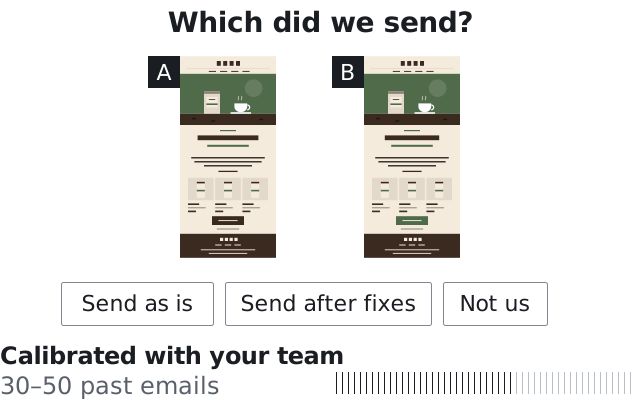
Your team calibrates the score, on your own past emails. Calibration is the step that makes Caliber’s review agree with your team’s judgement, and it configures your workspace; it doesn’t train or fine-tune a model on your content.
Scored by Caliber, judged by your team.
In the implementation, 30–50 of your past emails will be scored by Caliber and judged by your team, and the rubric will be adjusted until the two agree. Calibration will be repeated every quarter against recent sends.
A change to the rubric or the scorer will mean the scorer is measured again, and until it is, its scores will be marked provisional. The six-week pilot is where this happens first.
05 / The score
What can the score do, and what can’t it?
The score informs a decision; it never makes one. It will show how a draft reads against your guide and where it falls short, and a named person decides.
-
It never approves.
A good score is not a sign-off.
-
It never blocks on its own.
A low score will not stop a draft from being reviewed. The approver reads it and decides.
-
It says when it is unsure.
When the range straddles your pass mark, the score will say so.
-
Not scored is never clear.
A rule that could not be scored will show as not scored, never a pass.
06 / Sign-off
Who signs off, and on what?
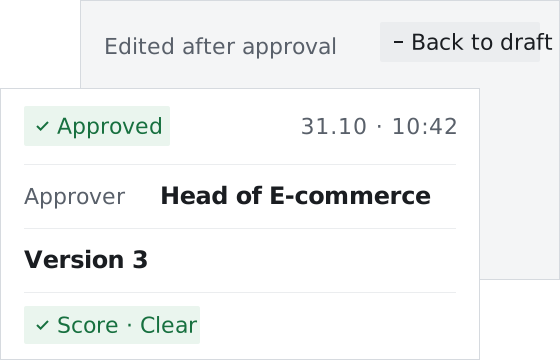
A named person signs off each email, on one version. The approval will be recorded with their name, the time, and the score and findings they saw when they approved.
Nobody will be able to approve work they edited.
If the email changes after approval, it will return to draft and need approval again, so what reaches the ESP is what was approved.
Caliber will then put the email in your team’s ESP as a draft.
Where Caliber stands
Finished emails. In your brand. In your ESP.
- Stage
- Caliber Email is pre-launch, and early access opens to small groups in turn.
- Integrations
-
- Klaviyo
- Braze
- Salesforce Marketing Cloud Next
- Voyado
- Customer.io
- Iterable
- Sign-off
- A named person approves every email.
07 / Questions
Questions
Will AI dilute our brand?
Not past your guide. Caliber will use a language model to write copy and to read for voice, but your guide sets the rule: word rules are matched in code, voice is scored against the rubric your team calibrated, and every email waits for a named person’s sign-off. The method serves the guide, never the other way round.
Who owns the brand guide?
Your brand does. The guide will be held as versioned data in your brand’s own workspace, and every dimension, weight and rule in it is one your team set. Caliber holds no rubric of its own, and nothing in one brand’s workspace is read when Caliber works for another.
Does Caliber train a model on our content?
No. Calibration configures your workspace; it doesn’t train or fine-tune a model on your content. Your past emails are used to set up your brand profile and to calibrate Caliber’s review with your team’s judgement, inside your own workspace.
Can a high score approve an email?
No. A score informs the decision, and it never approves an email on its own. Each email will be approved by a named person, on one version. If it changes after that, it will return to draft and need approval again.
What if our team disagrees with a finding?
Then the team dismisses it. A finding is Caliber’s reading of your guide, not a verdict. Where the team and the score keep disagreeing, that is what calibration is for: the rubric will be adjusted until Caliber’s review and your team’s judgement agree.
See your own guide as a rubric.
Early access opens to small groups in turn. Bring your brand guide and a few emails you are proud of.